Week of July 26 - Aug. 1, 2026
In a couple of weeks, I'll be telling you about the annual Perseid meteor shower. It should be a good one this year since moonlight won't reduce our view. Of course, if you've read my column regularly, you already know that stargazers will almost always see more meteors in the hours before dawn than during the evening, so that means we must rise early or stay awake all night.
I know either can be quite a challenge for some, so this week I present to you an opportunity to practice getting up early and heading outdoors. Not for meteors — though you will almost certainly spot some early Perseids in the early morning sky — but to see two planets that haven't been visible during the evening hours for quite a while.
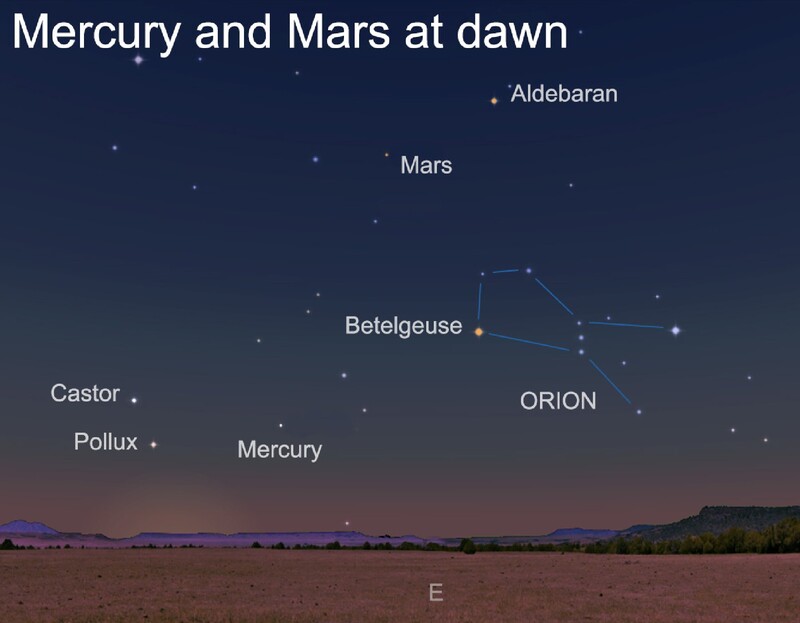
During early dawn this week, early risers have the chance to see the only two planets of our solar system whose names begin with the letter M: Mars and Mercury.
Before sunrise, look midway up in the eastern sky, and you'll spot a fairly bright reddish-orange light. Many people may think that's the Red Planet, but I assure you it's not. It's actually a star named Aldebaran, and it marks the fiery red eye of Taurus, the bull. Betelgeuse, in Orion, the hunter, also appears the same color.
It's true that Mars also appears reddish-orange, but at this time, it appears 1.5 times fainter than Aldebaran and can be found to its lower left. Because it's so faint, you may have a tough time seeing its color easily, but aim binoculars or a small telescope in its direction and its ruddy hue will become quite apparent.
Mars changes its distance from Earth, and therefore its brightness, quite dramatically over its orbit around the sun. It can go from about 35 million miles from us at its best oppositions; the next of these won't occur until September of 2035, when it will lie just 35.8 million miles from us. That will be a great time to view the planet with a small telescope, but right now, Mars lies nearly 186 million miles from us and appears quite small and faint.
The other planet visible in the early morning hours this week is the elusive planet Mercury. I use the word elusive because this planet is the closest to the sun of all our solar system's worlds and, as such, never strays far from its glare. With its orbital motion combined with that of the Earth, Mercury flips from dusk to dawn about every three or four months, but it's always rather tough to spot.
It's been said that the great 16th-century Polish astronomer Nicolaus Copernicus, who overturned the long-held notion that the Earth occupied the center of our planetary family, had never actually seen this world with his own eyes. Now I don't know if this is true, but it makes sense given what we know about weather conditions in Eastern Europe and how challenging Mercury is to spot.
This week you can achieve something even the great Copernicus never could ... but you've got to get up pretty early to do it!
Visit Dennis Mammana at dennismammana.com. To read features by other Creators Syndicate writers and cartoonists, visit the Creators Syndicate website at www.creators.com.
Mars and Mercury will be visible before sunrise this week.







View Comments